
Serverless Cloud Architecture Guide for SaaS
Building modern software shouldn't require managing physical hardware or patching virtual machine operating systems all weekend. This serverless cloud architecture guide reveals how modern SaaS teams build highly scalable applications without babysitting server infrastructure. Traditional cloud provisioning forces teams to pay for idle virtual machines 24 hours a day. Switching to an event-driven design changes the game. Your backend code runs only when triggered by live user HTTP requests, queue messages, or database updates.
Table of Contents
- 1. Navigating Modern App Development with Serverless Systems
- 2. Architectural Foundations of Serverless Systems
- 3. Practical Blueprint for Building Scalable Infrastructure
- 4. Analyzing Cold Starts and Cloud Cost Models
- 5. Enterprise Reliability via Authentic Deployment Solutions
- 6. Implementing Cloud Security and System Observability
- 7. Master Your Migration Strategy with InDevXo
Think of traditional servers like a leased apartment. You pay monthly rent regardless of whether you're home or traveling. Serverless computing acts more like a rideshare service. You pay strictly for the exact milliseconds your code runs. That shift slashes maintenance overhead and automatically scales your application compute power from zero to thousands of simultaneous requests.
Engineers sharing real-world experiences in Reddit's serverless technical community point out that this pattern shines brightest for workloads with spiky activity patterns. If you handle data ingestion, automated web crawling, or unpredictable API traffic, event-driven functions absorb those surges without manual scaling intervention.
Leading cloud products like AWS Lambda handle function execution, while framework solutions like Serverless Framework simplify backend infrastructure definition. Configuring these services manually can still lead to security misconfigurations or billing surprises. InDevXo offers guaranteed authentic Cloud Deployment solutions direct from the official provider. Our direct service ensures your cloud infrastructure follows vendor-verified configurations right out of the box.
This walkthrough by Be A Better Dev demonstrates how developers use Infrastructure as Code to automate serverless setups cleanly.
Following a clear serverless cloud architecture guide allows software teams to spend energy on features instead of server maintenance. Pairing cloud-native design patterns with official environment deployments helps startups and growing businesses scale with confidence.
How Does Serverless Cloud Architecture Actually Work?
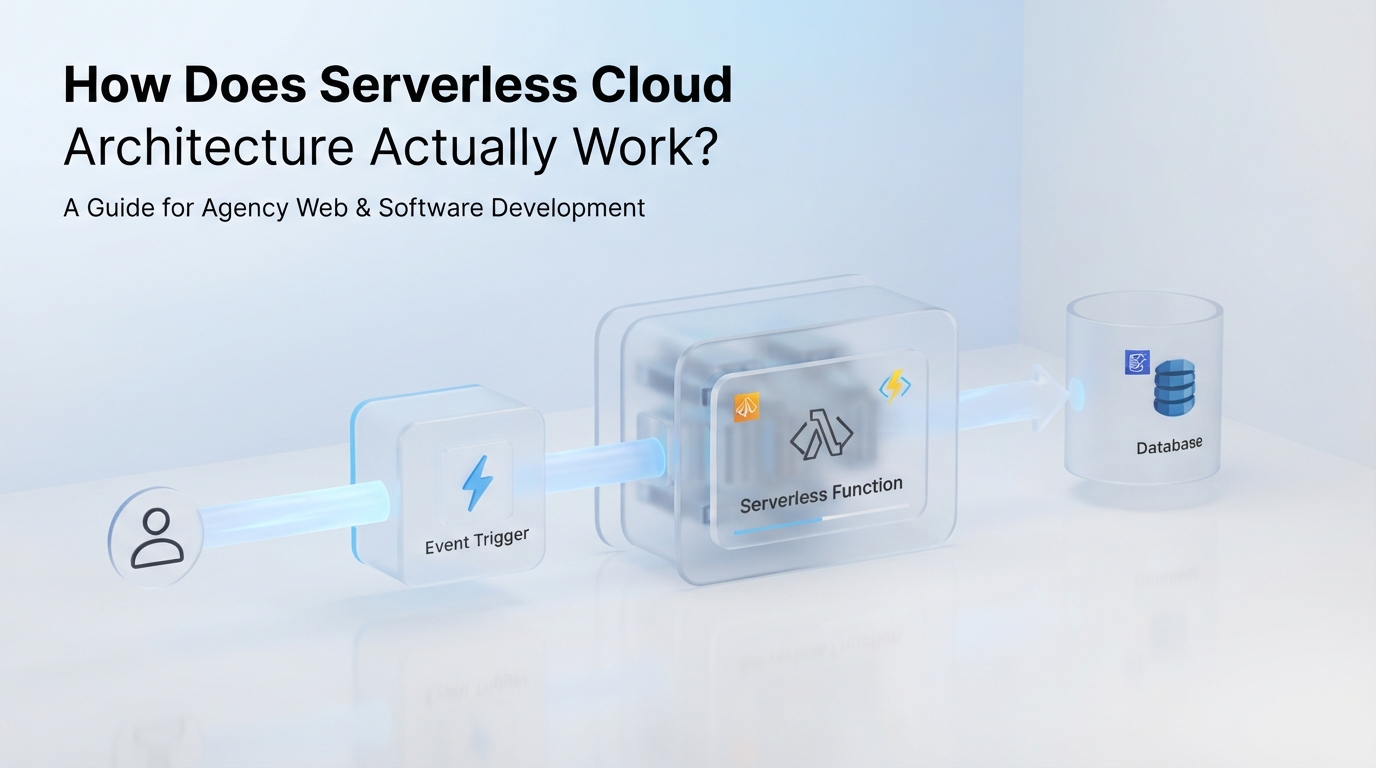
Imagine renting a commercial kitchen full-time just to bake one batch of cookies a week. You pay electricity, rent, and maintenance around the clock. That's traditional server hosting. Serverless computing flips this model entirely. You walk into a kitchen, bake your cookies for twenty minutes, pay only for those twenty minutes, and walk away. The cloud vendor cleans up the mess and handles the building upkeep.
Developers often struggle with the name. Don't let it fool you. Servers still exist, but you never see, patch, or manage them. Cloud providers handle hardware provisioning, operating system updates, and automatic scaling automatically.
"With serverless, AWS manages the underlying infrastructure... You simply provide it instructions on how you want your code to run." — As highlighted in developer discussions on AWS serverless mechanics.
Deconstructing Ephemeral Containers, FaaS, and BaaS
To understand how code executes on demand, we need to split serverless into two primary building blocks: Function-as-a-Service (FaaS) and Backend-as-a-Service (BaaS). Together, they form the foundation of any modern serverless cloud architecture guide for building scalable apps.
Function-as-a-Service (FaaS) is your custom application logic broken down into small, isolated functions. Industry-standard tools like AWS Lambda or Google Cloud Functions host these snippets. When a user clicks a button on your SaaS platform, the cloud provider spins up a lightweight container in milliseconds. This container is ephemeral. It lives only long enough to run your code and return a response before disappearing into thin air.
Backend-as-a-Service (BaaS) covers external services that handle standard backend tasks so you don't have to write custom code. Think of managed authentication services like Auth0, or managed cloud databases like Firebase and DynamoDB. Instead of maintaining a server database cluster, you simply call an API to fetch your data.
The video above from Cloud Guru breaks down how these building blocks interact during real-world cloud requests.
How Event Triggers Drive Execution
Serverless code doesn't run continuously. It sits idle until an event awakens it. These events act like digital light switches turning your functions on and off instantly.
Common event triggers include:
- API Requests: A client sends an HTTP request through an API Gateway, invoking a backend FaaS function.
- Database Mutations: A new user signs up, inserting a database row that automatically triggers a welcome email function.
- File Uploads: A customer uploads a profile photo to object storage, triggering an image resizing script.
- Scheduled Tasks: A timer fires every midnight to generate daily revenue reports.
Setting up these pipelines cleanly requires careful orchestration. Misconfiguring event sources or service permissions can lead to unexpected delays or broken API routes. If you want a seamless setup without the headache of manual configuration, opting for an official Cloud Deployment setup from InDevXo guarantees authentic, pre-configured infrastructure templates right out of the box.
By linking FaaS and BaaS through event triggers, developers build complete software applications that scale from zero requests to millions overnight, without buying a single virtual server ahead of time.
The Practical Serverless Cloud Architecture Guide for Building Scalable Systems
Building systems at scale used to mean renting fixed servers and praying they wouldn't crash during traffic spikes. Serverless changes that completely. You write code, push it, and let the cloud provider run it only when triggered. It's like paying for electricity only when you flip on a light switch, rather than keeping a massive diesel generator humming in your backyard around the clock.
When following a practical serverless cloud architecture guide, your main goal is breaking apart tight connections between components. Monolithic applications lump user profiles, payment handling, and background jobs into one running block. If one part breaks, everything drops. Serverless splits those jobs into small, independent functions that run only when work shows up.
Applying This Serverless Cloud Architecture Guide to SaaS Topologies
Engineers in AWS community architectural discussions on horizontal scaling frequently ask how to scale backends without constantly rewriting code. The answer starts with three foundational patterns: gateway integrations, asynchronous event queues, and microservices orchestration.
| Architectural Pattern | Core Mechanics | Best Application |
|---|---|---|
| API Gateway Routing | Acts as a front door, translating HTTP requests directly into backend function invocations. | RESTful APIs, webhooks, user authentication endpoints. |
| Asynchronous Event Streams | Publishes events to queues (like AWS SQS or Kafka) so functions process workloads out-of-band. | Order processing, email notifications, media rendering. |
| Stateful Orchestration | Uses state machines to chain serverless functions together with built-in retry logic. | Multi-step checkout workflows, data transformation pipelines. |
API gateways process incoming requests and pass them to backend functions without keeping persistent server connections open. This keeps your system light. For long tasks like generating PDF receipts or processing images, pushing work into an asynchronous event stream prevents user-facing requests from timing out.
Watch this walkthrough by Brolly Academy to see how event streams and serverless execution models coordinate real-time backend data flows:
Connecting functions directly to traditional relational databases can cause sudden connection exhaustion. Serverless applications scale up instantly, opening thousands of rapid connections that can paralyze standard database engines. Use connection proxies or switch to serverless-native data stores like AWS DynamoDB or Azure Cosmos DB that handle rapid scaling naturally.
"Instead of a monolithic architecture where the entire application runs as a single engine, serverless breaks work into atomic units triggered by system events."
Orchestrating complex microservices requires managing workflow state without storing data inside your execution logic. Functions should remain stateless. Use service orchestrators like AWS Step Functions or Azure Logic Apps to manage sequence flow, retries, and error handling across independent steps.
// Example EventBridge event trigger pattern
{
  "source": "saas.payment",
  "detail-type": "PaymentCompleted",
  "detail": {
    "orderId": "ord_9921",
    "status": "SUCCESS",
    "amount": 49.00
  }
}
Setting up production-ready serverless environments manually takes time and creates setup risks. You can get official enterprise configuration templates through our verified Cloud Deployment setup directly from InDevXo. This gives you authentic infrastructure blueprints tuned for production workloads without manual configuration headaches.
Frequently Asked Serverless Topology Questions
How do I handle database connections when functions scale up quickly?
Use a database proxy server or connection pooler between your functions and your database. Proxies hold open a stable set of connections and share them across incoming short-lived function invocations.
Can I convert an existing monolith into a serverless topology all at once?
Don't try to rewrite everything overnight. Migrate edge routes one by one using API gateway paths to divert traffic incrementally while leaving core database logic running in your existing backend.
What Are the Core Trade-Offs of Cold Starts and Cost Models?
What is serverless cloud architecture? It's a design pattern where you run applications without managing underlying servers. The cloud provider handles machine maintenance, operating system patches, and instant scaling. You pay only for the exact milliseconds your code runs. But this hands-off comfort brings real technical trade-offs. You swap server maintenance headaches for latency spikes, execution limits, and complex resource billing rules.
Navigating Cold Starts in Your Serverless Cloud Architecture Guide
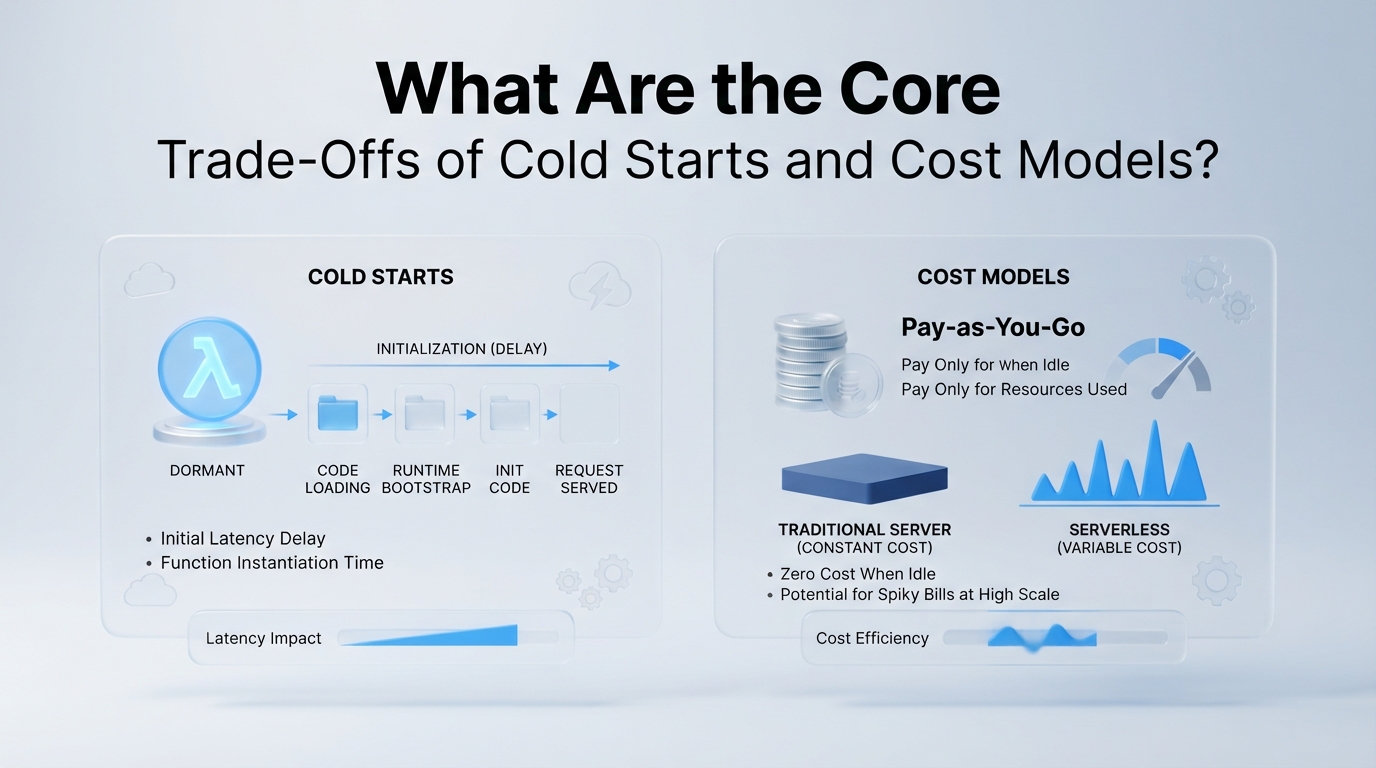
Think of a serverless function like a food truck burner. When orders stop coming in, the owner turns off the stove to save gas. When a customer arrives, the owner must relight the burner and chop ingredients before cooking. That initial setup delay is a cold start.
When your function sits idle, the cloud engine tears down its execution container. A fresh incoming request forces the platform to spin up a new container, import your code, and launch runtime dependencies. If your codebase is heavy, users feel a noticeable lag. As highlighted in Reddit discussions on Lambda warmness tradeoffs, developers often attempt to ping functions on a timer to keep them warm. Doing that constantly burns money on idle compute invocations.
Cold starts hit hardest during sudden traffic spikes. When hundreds of users hit an API at once, the system spins up dozens of fresh containers simultaneously. You can eliminate these delays using provisioned concurrency. This setting keeps a fixed pool of execution environments pre-warmed and ready to process traffic instantly.
Common Serverless Bottlenecks and Architectural Questions
Engineers often compare trade-offs before choosing serverless over classic server setups. Here is how key architectural questions break down in practice.
What are the downsides of a serverless architecture?
The main downsides are cold start latency, tight execution timeouts, vendor lock-in, and unpredictable bills under constant heavy load. Most providers enforce a hard execution limit (such as 15 minutes per function call). If a long-running batch job exceeds that time window, the system kills it instantly.
Is serverless better than Kubernetes?
Neither option is universally better. Kubernetes gives you complete control over containers and predictable fixed billing for steady, round-the-clock traffic. Serverless shines when your app experiences variable traffic patterns, automatically scaling down to zero cost when idle.
Is S3 considered serverless?
Yes. Amazon S3 is a classic serverless object storage engine. You upload and retrieve files without managing disk volumes, storage clusters, or OS updates.
Tuning Execution Time and Memory Allocation
Cloud providers bill serverless execution using gigabyte-seconds. You pay for the memory size you assign multiplied by how long your code takes to run. Increasing assigned memory gives your function proportionate CPU performance. Sometimes giving a function more RAM actually lowers your total bill because your code completes in a fraction of the time.
As noted in community advice on solving Lambda shock loads, pairing right-sized memory configs with provisioned concurrency protects your apps from execution bottlenecks. The table below outlines how memory allocation affects performance and cost dynamics.
| Memory Configuration | Processing Capability | Execution Duration | Ideal Workload Type |
|---|---|---|---|
| 128 MB to 256 MB | Single-core low compute | Slower overall execution | Simple HTTP redirects, small webhooks |
| 512 MB to 1024 MB | Balanced CPU performance | Moderate execution speed | REST APIs, database queries |
| 2048 MB+ | Multi-threaded high compute | Fastest execution time | Image conversion, data transformations |
Part of mastering any modern serverless cloud architecture guide involves balancing execution speed against your infrastructure budget. Assigning too little RAM causes timeouts and failed API calls. Assigning too much memory to simple tasks wastes money.
Configuring production systems requires deep architecture knowledge. For production apps, setting up cloud environments without vendor expertise creates reliability risks. Our authentic Cloud Deployment solutions at InDevXo provide direct, verified cloud infrastructure setups. We help you establish optimal memory allocations, cold start defenses, and execution timeouts right out of the box, ensuring high reliability for your systems.
Why Official Cloud Deployment from InDevXo Essential for Enterprise Reliability
Building on custom scripts or random online templates leaves your software vulnerable. When enterprise apps crash during peak traffic, it costs thousands of dollars per minute. Reliability in cloud computing simply means your app stays online, performs fast, and heals itself whenever a hardware node fails. It works just like an automatic emergency backup generator in a modern hospital.
What is a serverless cloud architecture? It is an on-demand setup where cloud vendors handle server maintenance, scaling, and security patches while you pay only for the exact milliseconds your code executes. Many system admins share stories in DevOps community discussions regarding operational burden about spending late nights fixing broken operating system updates. Moving to verified serverless setups eliminates those endless maintenance headaches.
Enterprise Infrastructure Standards in This Serverless Cloud Architecture Guide
Enterprise teams can't afford experimental setups. Using unverified templates to launch production workloads creates major security leaks and audit failures. Following a clear serverless cloud architecture guide helps your engineering team avoid configuration traps while meeting strict regulatory standards.
We built our official Cloud Deployment service at InDevXo to give you a guaranteed authentic infrastructure direct from the official provider. Instead of wrestling with broken permissions or guessing network policies, our service delivers verified environments backed by full vendor support. This authentic setup guarantees your production systems run reliably right out of the box.
Standardizing Enterprise Strategy: Industry experts in Perforce's insights on enterprise cloud strategy emphasize that cloud reliability depends on consistent resource provisioning and tight access controls across all environments.
Engineers often ask: is serverless better than Kubernetes? Serverless wins when you want zero server management, instant auto-scaling, and lower costs for unpredictable traffic. Kubernetes is better if you run steady, continuous processing tasks that require granular control over operating system settings.
Knowing when not to use serverless saves your project budget. Avoid serverless for heavy batch-processing jobs that run continuously for hours. You should also skip it for legacy monolith apps that you can't break down into small, independent functions.
- Direct Provider Backing: Guaranteed authentic infrastructure setups fully backed by official vendor support.
- Built-In Compliance: Pre-configured identity policies that pass strict enterprise security audits on day one.
- Zero OS Management: No need to patch operating systems or manage virtual server hardware manually.
- Controlled Costs: Prevent unexpected billing surprises caused by misconfigured infrastructure scripts.
How to Implement Robust Serverless Security and Observability
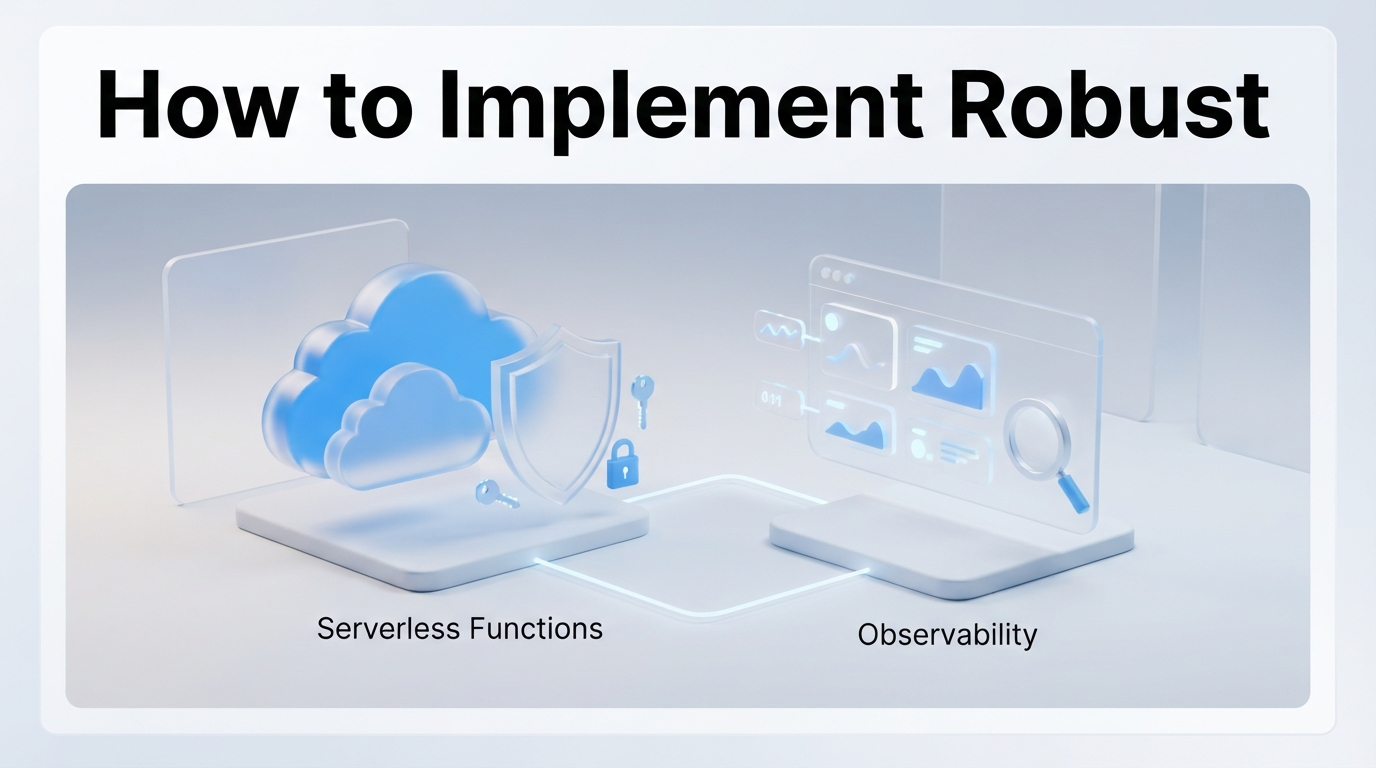
Serverless removes hardware management completely. You don't have to patch host operating systems or swap out failing hard drives. Cloud providers handle physical server health behind the scenes. However, as platform engineers on Reddit's cloud architecture forum point out, serverless doesn't eliminate operational complexity—it shifts it into identity permissions and event connections. Without strict guardrails, a single vulnerable function can compromise your entire system.
Applying IAM and Zero-Trust in Your Serverless Cloud Architecture Guide
Think of Identity and Access Management (IAM) policies like keys to a secure office building. You wouldn't hand a master key to a guest worker who only needs to clean one desk. Serverless functions work the same way. Every individual function requires its own minimal key ring. Give functions exact permissions for exact resources. If a background worker reads data from a queue, it shouldn't have rights to delete database rows or upload public files.
Zero-trust network design steps in right where identity management ends. Never assume a request is safe just because it came from inside your cloud account. Route your serverless functions through isolated Virtual Private Cloud (VPC) endpoints. Keep public internet access closed unless an external API connection strictly requires it. By enforcing these perimeter controls, you prevent lateral movement if an attacker injects code into an isolated runtime environment.
Field Rule: Assign one dedicated IAM role per function. Shared microservice roles create invisible backdoors across your event pipeline.
Building resilient security guardrails takes time and deep cloud experience. If you need verified infrastructure blueprints without guessing policy syntax, our official Cloud Deployment service direct from InDevXo delivers pre-configured IAM roles and zero-trust VPC templates ready for production. It offers direct-from-provider guarantees, giving your team authentic setup patterns built by senior cloud engineers.
In this conference talk, security researcher Itay Rozenman explains why ephemeral function runtimes require fundamentally new security strategies compared to standard monolithic servers.
Mastering OpenTelemetry and Distributed Tracing across Event Pipelines
Traditional monitoring asks simple questions: "Is the virtual machine powered on?" Serverless observability answers harder questions: "Why did user checkout request #9204 stall for three seconds inside an event bridge?" Functions launch, execute in 150 milliseconds, and terminate. You can't log into a container that stopped existing five minutes ago.
Distributed tracing solves this diagnostic puzzle. OpenTelemetry standards attach a unique trace ID to every payload arriving at your API gateway. As that payload triggers queues, database updates, and downstream events, the trace ID tags along. It creates a digital breadcrumb trail spanning your entire infrastructure.
- Centralized Logging: Aggregate standard stdout log outputs into platforms like AWS CloudWatch or Datadog so developers don't have to grep individual execution instances.
- Correlation IDs: Pass context headers across every HTTP request and message bus to link isolated function logs together instantly.
- Metric Alarms: Set automated alerts on error rates and duration spikes rather than relying on standard CPU usage figures.
When maintaining a production-grade serverless cloud architecture guide for high-throughput SaaS, raw log volume expands quickly. Standardizing on structured JSON logs makes searching fast and keeps index costs under control. We've seen engineering teams cut debug times in half simply by enforcing uniform log formats across all services.
| Observability Layer | Traditional Server Architecture | Modern Serverless Cloud Architecture |
|---|---|---|
| Health Monitoring | CPU utilization, RAM consumption, disk I/O | Function duration, concurrency limits, throttle counts |
| Debugging Approach | SSH into active instances to tail log files | Follow distributed trace paths via OpenTelemetry standards |
| Network Inspection | Packet sniffing on static network interfaces | VPC flow log analysis and service map visualization |
Adopting these tracing standards transforms raw event data into clear operational insights. To explore standard telemetry protocols in detail, review the official OpenTelemetry protocol architecture guide for implementation examples.
Master Your Serverless Migration with Verified Cloud Deployment
Moving to event-driven infrastructure changes how software teams design SaaS applications. Shifting away from standard virtual servers lets developers release updates faster while cutting down on idle runtime costs. It's a huge operational win. Still, untangling legacy systems isn't always straightforward. As experienced system architects note in Reddit AWS migration discussions, mapping out service dependencies early prevents costly re-architecture work down the road.
Executing Your Serverless Cloud Architecture Guide Strategy
Success comes down to mastering state management, managing cold start latencies, and building reliable infrastructure pipelines. You don't want to run database scripts at runtime or mix up your deployment environments. Applying this serverless cloud architecture guide ensures your team builds resilient SaaS systems that scale smoothly during traffic spikes without triggering unexpected bill shocks.
To see how modern backend services connect with cloud database layers, watch the video above by Code with Jay. It shows how event-driven functions interact with persistent storage setups in production environment workflows.

Don't leave your deployment security or setup stability to guesswork. We've seen too many engineering leads fight broken configuration templates during critical product launches. Securing your cloud foundation requires a straightforward path straight from your codebase to live infrastructure.
Building event-driven systems frees your team to focus on product features instead of server maintenance.
That's why forward-thinking development teams rely on official Cloud Deployment directly from InDevXo. It gives you a guaranteed authentic deployment setup straight from our engineering specialists. You get total peace of mind, rapid adoption, and direct support from the official provider so your cloud workloads run reliably from day one.