

RAG Architecture vs Fine-Tuning LLMs Strategy - rag architecture vs fine tuning llms
Every enterprise team eventually faces a massive technical crossroads when connecting foundational artificial intelligence models to private business data. Evaluating a rag architecture vs fine tuning llms represents the defining strategy decision for modern engineering leaders. Out-of-the-box base models don't know your confidential customer histories, internal codebases, or proprietary documentation. Raw models guess. We've seen hundreds of enterprise teams struggle to bridge this gap cleanly.
Table of Contents
- Navigating Generative AI Customization: RAG vs Fine-Tuning
- What Is RAG Architecture vs Fine Tuning LLMs in Practice?
- How Do RAG and Fine-Tuning Handle Dynamic Enterprise Data?
- Why Does Fine-Tuning Cost More Than RAG to Maintain?
- Which Approach Minimizes LLM Hallucinations and Improves Explainability?
- When Is Fine-Tuning Superior for Tone, Style, and Task Mastery?
- How to Choose Between RAG and Fine-Tuning for Your AI Architecture?
- Building a Resilient Enterprise GenAI Strategy
Retrieval-Augmented Generation acts like an open-book exam for your AI application. Instead of re-training the network, RAG pulls fresh facts straight from an external database—such as a fast Pinecone vector search index—and hands that knowledge to the model alongside your prompt. Fine-tuning works differently. It rewires the internal memory weights of a neural network using platforms like the OpenAI custom model tuning documentation to teach it specialized behavior, unique writing syntax, or strict formatting styles.
Industry data shows massive market growth in scalable pattern design. Learning how a rag architecture vs fine tuning llms handles real-time knowledge updates lets you pick the right setup without burning your budget. Trade-offs around model hallucinations, maintenance costs, dynamic data access, and setup complexity will dictate your team's success. Let's explore how these powerful customization paths compare in production.
What Is RAG Architecture vs Fine Tuning LLMs in Practice?
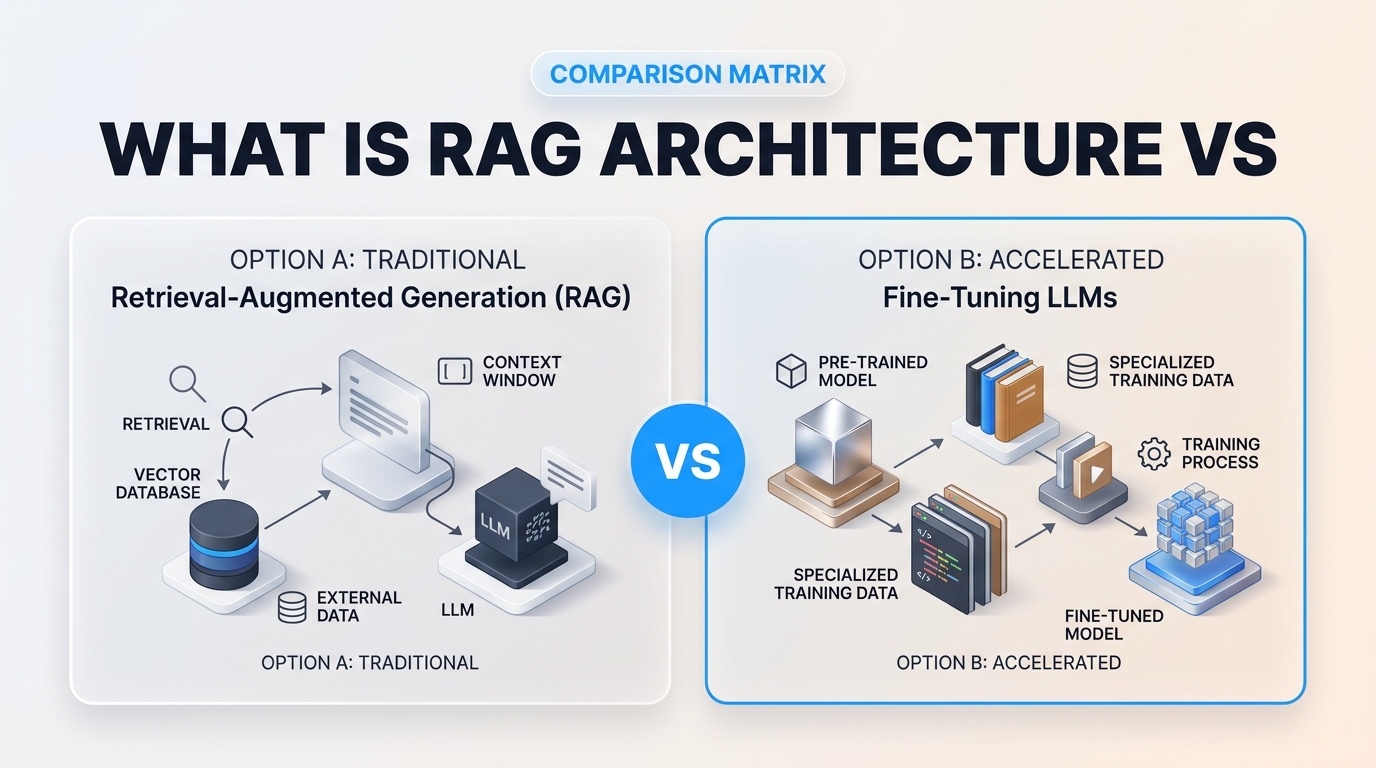
Imagine hiring a brilliant researcher for your organization. They know almost everything published up to a certain point, but they don't know your private corporate files. You've got two clear paths to make them useful. You can hand them a well-organized filing cabinet every time they answer a question, or you can send them back to university for months to re-train their brain. That choice mirrors how software teams adapt artificial intelligence today.
Demystifying RAG Architecture vs Fine Tuning LLMs in Real Operations
Retrieval-Augmented Generation (RAG) acts like an open-book exam. The base model's core brain stays completely untouched. Instead, we connect the large language model to an active search engine and database pipeline. When a user submits a query, the system searches an external vector database for matching facts. It pulls those fresh snippets and inserts them into the context window right next to the question.
Developers frequently use orchestration platforms like the LangChain framework ecosystem alongside specialized tools like the Pinecone vector database to store and retrieve these document embeddings instantly. The model reads the retrieved text and drafts a clean response on the spot. It never permanently memorizes your data. It simply reads the notes you hand it.
Fine-tuning takes a completely different route. Think of it as intensive skill training. Engineers take an existing base model and run it through additional training cycles using specialized datasets. This process directly modifies the internal weights and parameter layers inside the neural network. Lightweight techniques available through the Hugging Face PEFT library allow teams to adjust tiny portions of those weights without renting massive GPU clusters.
Core Difference: RAG changes what the model knows at runtime by attaching searchable real-time memory. Fine-tuning changes how the model behaves and outputs by reshaping its internal neural wiring.
Evaluating rag architecture vs fine tuning llms comes down to your core objective. Are you trying to give a model access to shifting business documents, or are you teaching it to speak a precise language? Industry data highlights rapid growth in RAG deployments across enterprise environments because company records change continuously. Fine-tuning millions of parameters every night isn't practical. It costs too much money and demands heavy computing resources.
- RAG excels at knowledge expansion: Fetching real-time records, customer account updates, product catalogs, and policy manuals without modifying the underlying model.
- Fine-tuning excels at task specialization: Enforcing strict code syntax, generating structured JSON payloads, mastering medical terminology, or mimicking a distinct brand voice.
It's not always an either-or decision. Modern machine learning architectures often combine both. Teams frequently fine-tune a smaller model to learn a specific industry jargon, then plug that fine-tuned model into a RAG pipeline to pull current facts. That hybrid setup gives you total control over both form and content.
How Do RAG and Fine-Tuning Handle Dynamic Enterprise Data?
Dynamic Data Handling: RAG Architecture vs Fine Tuning LLMs
Imagine printing a 500-page hardcover manual for your support team. It looks fantastic on day one. By day three, your product team updates your return policy and drops your subscription prices. Your manual is now out of date. To fix it, you can't just swap one page. You have to edit the master file, send it back to the printer, and pay for an entirely new print run. Fine-tuning an LLM works just like that hardcover manual. It bakes knowledge directly into the model's parameters during training. Once that training run finishes, your data becomes a static snapshot frozen in time.
RAG handles constant change differently. Think of RAG as giving your AI assistant a high-speed digital web browser connected directly to your internal network. The model itself stays untouched, acting purely as a smart reader. When someone asks a question, the system queries your live database, grabs the latest document, and hands it to the model to summarize. When evaluating rag architecture vs fine tuning llms for dynamic operational data, retrieval strategies win on agility every time.
| Data Handling Metric | RAG Architecture | Fine-Tuned LLM |
|---|---|---|
| Data Freshness | Real-time (instant document updates) | Stale (limited to training snapshot) |
| Cost per Data Update | Low (vector embedding storage fees) | High (GPU compute and pipeline runs) |
| Time to Reflect Changes | Seconds to minutes | Hours to days |
| Data Access Control | Easy (apply user-level security permissions) | Hard (all trained data is visible to all users) |
Enterprise data moves fast. Recent industry shifts show massive investment growth heading into retrieval systems over static re-training. Companies realize that over 80% of their operational context changes daily. Re-running training pipelines every night isn't financially sustainable. We've seen teams burn thousands of dollars in cloud compute just trying to keep model outputs aligned with weekly inventory sheets.
RAG bypasses this retraining bottleneck. You simply upload new files into your knowledge stack. Vector databases like Pinecone vector search engines index the fresh text chunks in seconds. The next user prompt instantly pulls context from the updated file. You don't restart services. You don't re-train weights. Your system stays accurate without missing a beat.
If your underlying business data changes daily or weekly, fine-tuning will turn into a financial black hole. RAG lets you update your system's memory simply by dropping a fresh PDF into your cloud bucket.
Data orchestration frameworks like LlamaIndex data orchestration tools make this pattern easy to scale. They connect directly to your live data sources like Google Drive, SharePoint, or SQL databases. When a file changes, the system updates only the modified embeddings. When choosing between rag architecture vs fine tuning llms for volatile business environments, RAG delivers real-time updates while keeping your engineering overhead exceptionally low.
Why Does Fine-Tuning Cost More Than RAG to Maintain?
Cost Breakdown: RAG Architecture vs Fine Tuning LLMs in Production
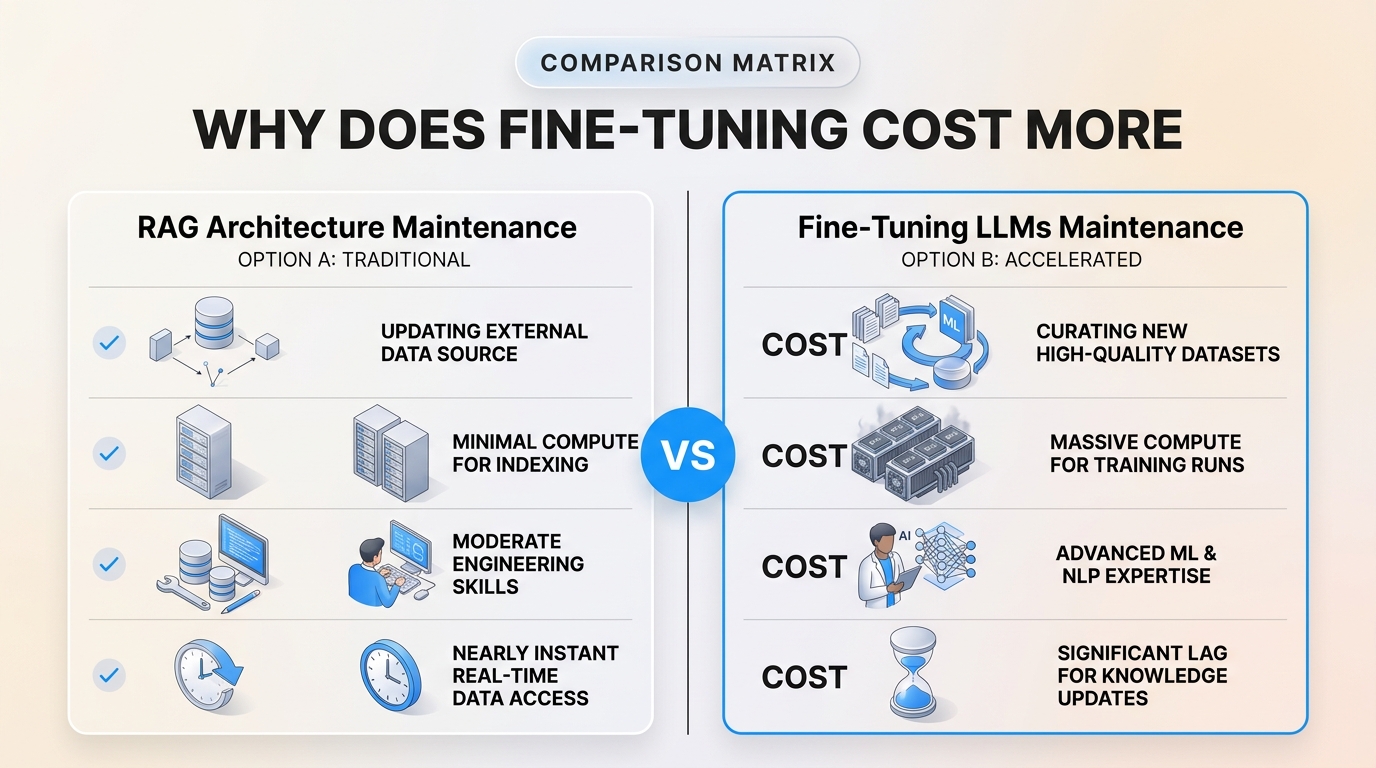
Maintenance costs catch most engineering teams off guard. When evaluating rag architecture vs fine tuning llms for long-term deployment, total cost of ownership extends far beyond initial API tokens. Building a prototype takes days. Keeping that system accurate for two years requires a steady stream of capital and computing power.
Think of an LLM as a brilliant medical student. Fine-tuning is like sending that student back to med school every time a medical journal updates its guidelines. It's thorough, but expensive and slow. Retrieval-Augmented Generation (RAG) is more like giving that same student open-book access to a digital library. When guidelines change, you simply swap out the page in the library. You don't pay to retrain the doctor.
| Cost Category | RAG Maintenance Requirements | Fine-Tuning Maintenance Requirements |
|---|---|---|
| Compute & Hardware | Low CPU/GPU footprint for lightweight embedding models and vector queries. | High GPU cluster overhead (NVIDIA A100/H100 instances) required for every retraining run. |
| Data Engineering | Automated document parsing, text chunking, and index updates. | Manual dataset formatting, prompt-completion pair curation, and data cleaning labor. |
| Knowledge Update Frequency | Real-time. Vectors insert into the index instantly without changing model weights. | Batch-based. Requires scheduled pipeline runs, validation testing, and model deployment. |
| Risk Mitigation | Stale chunks removed instantly from search indices. | Risk of catastrophic forgetting requires re-testing full benchmark suites. |
RAG maintenance centers on index management. You run background jobs to slice documents into smaller text blocks, run those blocks through an embedding model, and store them in platforms like Pinecone vector database services. Your primary ongoing bills cover vector storage space and the modest compute required to search top-k matching documents during a user query. When corporate policies change, your pipeline deletes the old database entries and embeds the new ones. The process takes seconds and costs fractions of a cent.
Fine-tuning flips this cost model on its head. Updating a fine-tuned model means you must re-run training pipelines on high-end hardware platforms like Anyscale managed AI infrastructure. Even with modern parameter-efficient techniques like QLoRA, spinning up GPU nodes costs serious money. Machine learning engineers must spend dozens of hours curating prompt-response pairs, removing corrupt data, and checking for bias.
Field Note: Data curation labor often costs five to ten times more than the raw GPU compute hours. A single dirty dataset can ruin a fine-tuned weight set, forcing your team to burn thousands of dollars on a repeat run.
Catastrophic forgetting adds another layer of financial risk to fine-tuning maintenance. When you train a model on new company information, it often forgets how to follow complex instructions or perform basic reasoning it learned previously. Engineering teams must run extensive regression test suites after every training run. If the model regression breaks safety guardrails, you throw out those training weights and start over. With RAG, your base model stays untouched and frozen, eliminating catastrophic forgetting entirely.
Which Approach Minimizes LLM Hallucinations and Improves Explainability?
Imagine taking a medical board exam. Fine-tuning turns your model into a student who crammed thousands of textbooks three weeks ago. The student recalls general concepts fast, but they might mix up drug dosages when pressed for precise numbers. RAG gives that same student an open-book reference manual during the test. When you compare rag architecture vs fine tuning llms for enterprise reliability, how each system handles facts becomes your main deciding factor.
AI models naturally guess the next word in a sequence. They don't check for factual truth out of the box. Fine-tuning adjusts internal neural weights to shape output style and domain language, but it doesn't create a reliable memory bank. Instead, the model stores facts as mathematical probabilities spread across billions of parameters. When a user asks a niche technical question, a fine-tuned model often stitches separate memory fragments together into a very confident lie.
Evaluating RAG Architecture vs Fine Tuning LLMs for Auditability
RAG stops this guesswork by changing how the model accesses knowledge. Rather than relying on frozen internal parameters, a RAG pipeline fetches current raw document passages from a vector store like Pinecone real-time index retrieval. It places those precise text snippets directly into the prompt payload before the model generates its response. The language model acts strictly as a processor, translating the provided facts into plain language.
Fine-tuning teaches a model how to act, while RAG tells the model what to know.
This structural difference directly impacts auditability. If an AI assistant gives an incorrect answer, compliance teams need to find out why immediately. The table below breaks down how each architecture handles fact verification and oversight in production.
| Evaluation Metric | Retrieval-Augmented Generation (RAG) | Fine-Tuned LLM |
|---|---|---|
| Data Source Location | External databases and searchable document stores | Internal model weights updated during training |
| Source Citation | Provides exact links to source files, paragraphs, or database rows | None; cannot produce verifiable reference links |
| Hallucination Risk | Low; bounded tightly by the supplied context window | Moderate to High; relies on static parameter recall |
| Debugging Process | Inspect retrieved context chunks using tools like Ragas framework for hallucination tracking | Inspect loss curves and training sets using Weights & Biases training run metrics |
Auditors want proof. If a fine-tuned model gives bad advice to a customer, you can't open up billions of floating-point numbers to find the exact line of code that failed. The decision process stays hidden inside a black box. You have to update your dataset and re-run expensive training jobs hoping the issue goes away without breaking other behaviors.
RAG fixes this explainability gap completely. Every response carries an exact paper trail. Your team can look at the retrieved background text to see if the error came from a bad search query or a poorly written source file. If a policy document changes, you update that single record in your database. You don't have to touch a single model weight to guarantee accurate, verifiable answers across your organization.
When Is Fine-Tuning Superior for Tone, Style, and Task Mastery?
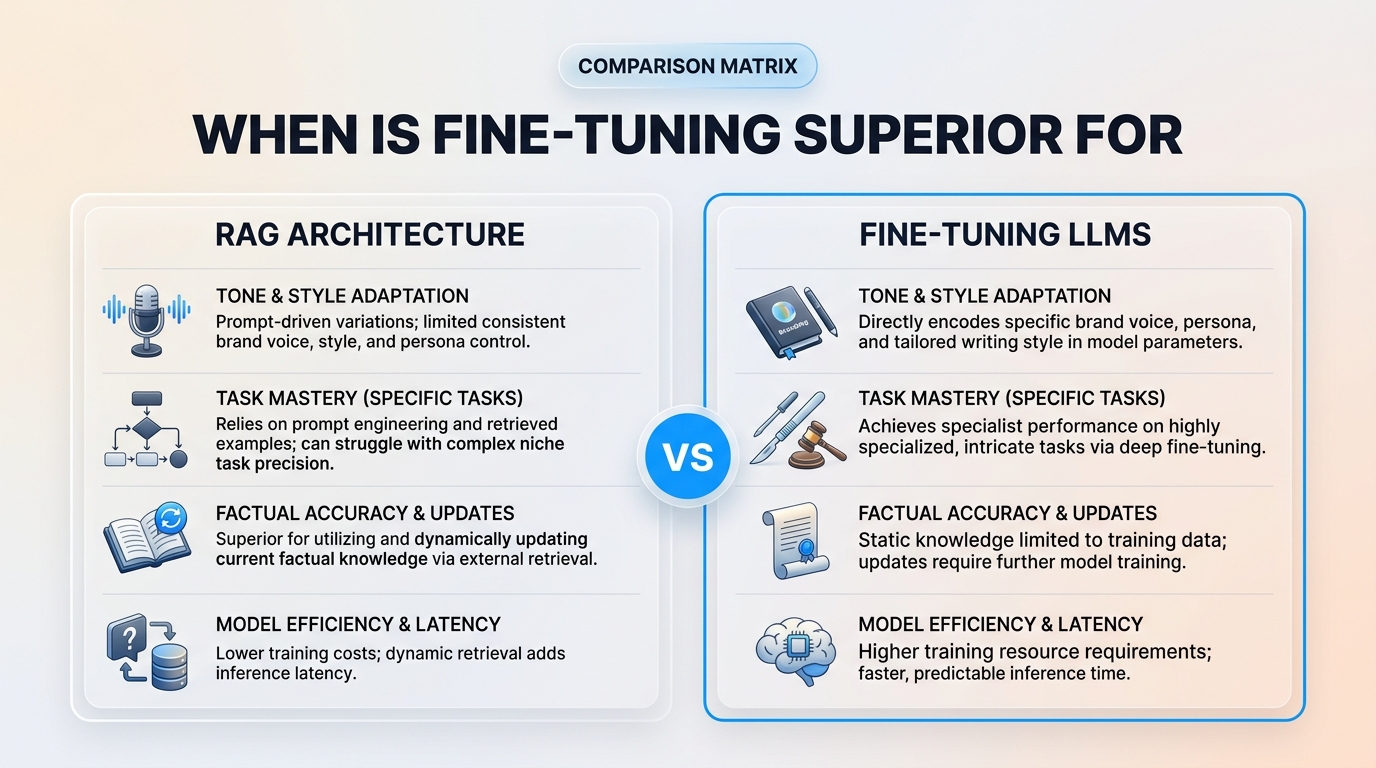
Think of retrieval-augmented generation as giving an actor a script to read live on stage. It works great for getting the facts right on the fly. Fine-tuning, on the other hand, is like sending that actor to dialect coaching for six months until they absorb a new persona completely. When your system must speak in a highly specific voice, stick to rigid data shapes, or follow rules without fail, reading off a cheat sheet isn't enough. You need built-in muscle memory.
RAG often stumbles when you ask it to alter how a model behaves rather than what it knows. If you stuff long instructions, formatting rules, and corporate tone guidelines into a prompt, the model gets confused. Context window bloat sets in, costs spike, and the likelihood of prompt injection increases. Fine-tuning bakes those instructions directly into the neural network weights, turning vague guidelines into automatic habits.
Why Fine-Tuning Dominates Style and Syntax in RAG Architecture vs Fine Tuning LLMs Comparisons
Developers quickly hit a wall when using RAG for structural precision. If your upstream software expects an exact JSON payload with twenty specific nested keys, standard prompting will eventually fail. The model might randomly throw in conversational filler or misplace a closing bracket during peak traffic hours.
| Requirement | Retrieval-Augmented Generation (RAG) | Fine-Tuned LLM |
|---|---|---|
| Strict Format Adherence | Requires massive system prompts; occasionally breaches schema under heavy load. | Outputs raw, valid schema (like JSON or XML) consistently without setup prompts. |
| Brand Voice & Tone | Mimics style based on few-shot examples, but easily drifts during long chats. | Permanently adopts specialized company jargon, persona, and linguistic habits. |
| Latency & Token Cost | High latency due to sending long context rules and retrieved chunks on every call. | Lower token consumption because style and formatting rules live in the trained weights. |
| Resistance to Injection | Vulnerable to user inputs that tell the model to ignore system prompt guidelines. | Extremely resistant; behavioral guardrails are deeply baked into the model architecture. |
When weighing OpenAI fine-tuning customization capabilities against dynamic retrieval strategies, fine-tuning wins hands down for recurring structured tasks. You don't need to re-teach the AI how to format a medical billing code or write a legal brief every time a user hits enter. The model already knows the drill.
"Prompt engineering tells a model what to do for one turn. Fine-tuning changes who the model is across every turn."
Consider specialized industries like specialized medical coding, financial auditing, or legal document transformation. These fields rely heavily on niche vocabulary that standard foundation models rarely see in general training sets. Fine-tuning a smaller model like Llama 3 or Mistral using tools like the Predibase enterprise LLM training platform allows you to achieve near-perfect task accuracy. You also get faster response times and significantly lower operational costs compared to feeding thousands of tokens into a massive general-purpose model over and over.
Is RAG useless for brand voice? Not entirely, but it's inefficient. If you want an assistant to sound like a witty 1920s detective while parsing complex internal server logs, prompting causes a clash between facts and flavor. The model spends so much energy remembering its accent that it misses details in the logs. Fine-tuning separates these concerns: train the base model to speak like a noir investigator natively, then use a light retrieval layer to supply the server logs. That hybrid setup gives you total voice control without sacrificing processing accuracy or latency budgets.
How to Choose Between RAG and Fine-Tuning for Your AI Architecture?
Picking the wrong path will drain your engineering budget fast. You don't want to build a complex rocket ship when a reliable bicycle gets you across the street. Think of Retrieval-Augmented Generation like giving your model an open textbook during a final exam. Fine-tuning is more like sending your model through years of medical school so it thinks and speaks like a specialist.
Every enterprise AI project balances four main trade-offs: data volatility, operational budget, required latency, and output formatting needs. We've built this simple breakdown to help your team pick the right path forward.
| Decision Factor | Retrieval-Augmented Generation (RAG) | Fine-Tuning LLMs | Hybrid Strategy |
|---|---|---|---|
| Data Volatility | Best for real-time, dynamic, or constantly changing data. | Best for static knowledge bases that rarely change. | Dynamic data plugged into a specialized domain model. |
| Operational Budget | Lower initial cost. High vector storage and retrieval fees. | High upfront training costs. Lower per-query token footprint. | Moderate upfront cost with optimized downstream inference. |
| Required Latency | Slower due to multi-step database lookups and search context. | Faster single-pass responses straight from model weights. | Balanced by using smaller, fine-tuned models for retrieval. |
| Output Formatting | Relies on prompt instructions. Can occasionally break format. | Strict compliance with complex JSON schemas or tone. | Enforces strict output rules while injecting dynamic facts. |
Evaluating Decisions in RAG Architecture vs Fine Tuning LLMs
How fast does your data change? That's usually the first question we ask engineering teams. If your knowledge base updates daily or hourly, fine-tuning will fail you. Re-training model weights continuously costs too much money and takes too long. RAG pulls fresh documents straight from database systems like the Pinecone vector database engine in milliseconds. It keeps your AI current without expensive re-training runs.
Budget constraints also dictate your choice. Fine-tuning requires specialized machine learning engineers and powerful GPU clusters. RAG lets your current software developers build smart systems fast. You can orchestrate data flows quickly using tools like the LangChain application orchestrator without touching a single model weight.
Speed matters too. RAG adds extra steps to every request. First, it searches your data. Then, it pastes that text into a prompt. Finally, the model reads the giant prompt and answers. That extra work adds network latency. Fine-tuned models keep knowledge inside their internal network. They answer faster because they don't need to read huge context windows on every turn.
Industry data shows massive growth potential in hybrid systems over standalone approaches. Early adopters realized that choosing between rag architecture vs fine tuning llms isn't an either-or decision anymore. The market is shifting heavily toward combining both methods to build production-grade enterprise software.
Consider how a hybrid architecture delivers the best of both worlds:
- Style and Tone: You fine-tune a lightweight model (like Llama 3 8B) on your company's internal communications style, medical shorthand, or strict legal formatting.
- Fresh Context: You connect that custom, lightweight model to an external retrieval framework using the LlamaIndex data framework to supply real-time account data.
- Cost Optimization: Smaller fine-tuned models cost far less to run than massive base models, while RAG keeps their responses accurate.
"Fine-tune for form, tone, and specific tasks. Use RAG for facts, fresh details, and strict verification."
Start with RAG to validate your product idea and map your data pipelines. If your outputs lack the right tone or fail strict formatting checks, introduce targeted fine-tuning to lock down behavior. This phased approach keeps your initial risk low while leaving room for deep customization as your system scales.
Building a Resilient Enterprise GenAI Strategy
Stop treating these two methods like rivals. Engineers often pit knowledge retrieval against model training, but successful enterprise applications combine both approaches into a multi-layered system. We've seen dozens of engineering teams waste months trying to pick a single winner when they actually need a phased implementation strategy.
Your team needs a pragmatic path forward. You don't need a massive upfront budget to get started with custom artificial intelligence.
Implementing RAG Architecture vs Fine Tuning LLMs in a Phased Roadmap
Start simple with retrieval. When evaluating rag architecture vs fine tuning llms for your initial rollout, building a retrieval pipeline gives your model immediate access to private company data without expensive GPU training. RAG acts like an open-book exam for your AI. It grabs real-time customer data, product catalogues, and support tickets from external sources using tools like the LangChain framework for context orchestration and stores them in vector indexes using Pinecone vector search infrastructure. This approach fixes knowledge gaps fast and keeps your answers grounded in real facts.
RAG handles the heavy lifting for knowledge access. But what happens when your model needs to speak in a specific brand voice or follow strict JSON output formats?
That's where model training comes in. Once your retrieval layer works reliably, introduce targeted model adjustments to refine output behavior. You can use platforms like Unsloth open-source fine-tuning tools to adjust smaller open-weights models like Llama 3 for specialized tasks. Fine-tuning acts like muscle memory. It teaches the base model custom syntax, unique domain jargon, and precise formatting rules that standard prompts struggle to enforce.
"RAG brings the facts to the table, while fine-tuning teaches the model how to behave at the meeting."
The ultimate goal isn't choosing between rag architecture vs fine tuning llms. The real win comes from combining them into a hybrid stack. RAG feeds your application fresh, searchable facts, while a fine-tuned small model processes those facts with perfect stylistic precision. This two-part approach keeps hosting costs low, reduces hallucination risks, and gives your business complete control over its generative AI roadmap.