
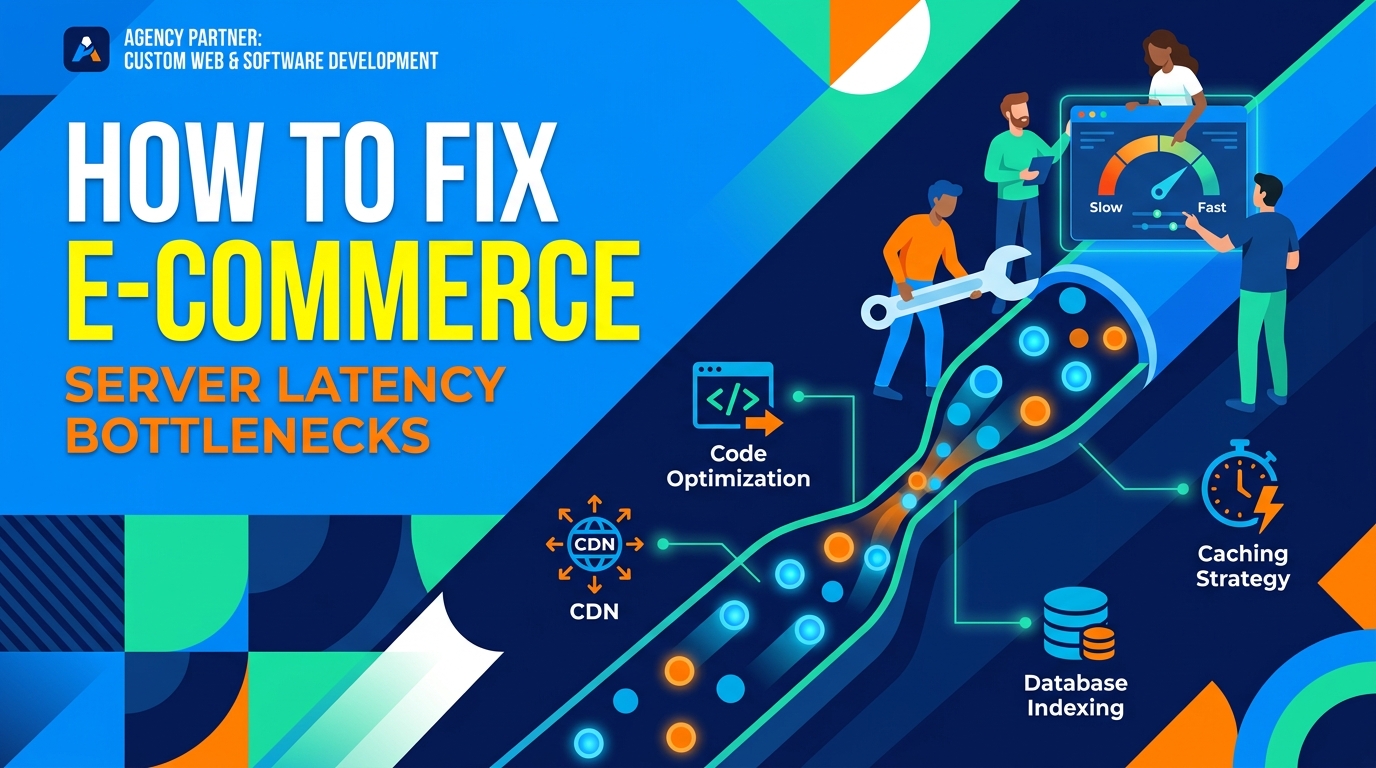
How to Fix E-Commerce Server Latency Bottlenecks - fix ecommerce server latency bottlenecks
Slow online storefronts drain profits quietly. When shoppers click a product, every millisecond of delay frustrates them. To protect your revenue, you must fix ecommerce server latency bottlenecks before buyers abandon their shopping carts. High server latency directly harms conversion rates, turning eager shoppers into lost sales. When backend infrastructure stutters, catalog pages freeze and checkout screens spin endlessly. Resolving server slowdowns is no longer optional for growing digital stores.
Table of Contents
- Why High Ecommerce Server Latency Kills Conversions Before Checkout
- How to Identify and Diagnose Backend Bottlenecks on High-Traffic Stores
- How to Fix Ecommerce Server Latency Bottlenecks with Targeted System Upgrades
- What Long-Term Architecture Prevents Server Slowdowns During Peak Traffic Sales?
- Eliminate Latency and Scale Your Online Store with Confidence
Time to First Byte (TTFB) measures how quickly a server answers a browser request. Think of it like a store clerk greeting a customer at the door. If the clerk takes five seconds to respond, the customer walks out. Industry benchmarks show that sub-second backend delays significantly lower conversions. Modern shoppers expect lighting speed. When asking what does 45 ms low latency mean, it refers to near-instantaneous processing where a server replies in 45 milliseconds, creating a seamless shopping journey. When TTFB climbs past 600ms, checkout timeouts spike, search filters lag, and cart abandonment rises rapidly.
Slow backend response times remain one of the most common problems faced by e-commerce businesses today. High server traffic overloads database queries, jams payment gateways, and slows catalog loading. According to Reddit discussions on store performance optimization, unnecessary server round-trips quickly degrade user experience and destroy ad conversion returns. Patching front-end scripts won't help if your database engine chokes under pressure. You need to address the root server bottlenecks directly.
To eliminate backend friction and maintain snappy page speeds under heavy loads, online merchants rely on tailored, high-performance infrastructure. Implementing our authentic Ecommerce Solutions directly from our platform provides direct-from-provider optimizations engineered to cure server delays and stabilize high-traffic checkouts. Fixing these backend roadblocks preserves revenue and builds long-term customer trust.
How to Identify and Diagnose Backend Bottlenecks on High-Traffic Stores
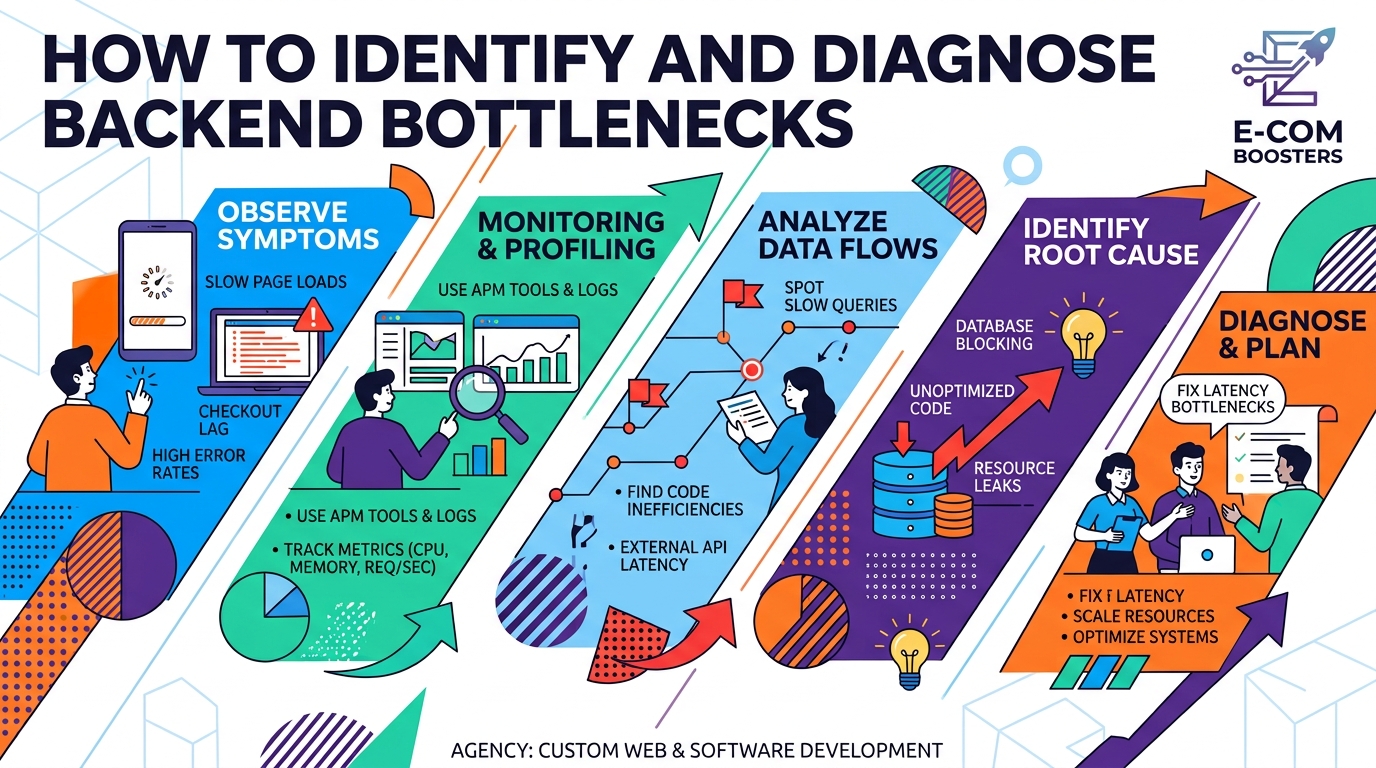
Finding the root cause of backend slowdowns during peak traffic sales requires a disciplined diagnostic framework. Experienced engineers follow a straightforward sequence: Detect → Diagnose → Solve → Measure. High-level telemetry alerts you when your store is struggling, but deep application tracing pinpoints the exact line of code or query stalling your transactions.
Isolating System Failures to Fix Ecommerce Server Latency Bottlenecks
When engineers evaluate how to find bottlenecks in performance testing or live production, they break the inspection down across four critical backend layers:
- Network and DevOps Infrastructure: Wondering how to identify network bottlenecks? You need to measure server I/O timings, packet drop rates, and load balancer queuing. If you are learning how to identify bottlenecks in devops environments, check your container resource quotas and ingress controller routing limits first. Bandwidth saturation often chokes data long before your app code executes.
- Database Lock Contention: Database queries are the primary failure point for high-volume stores. When hundreds of shoppers check out simultaneously, unindexed database reads and row-level write locks back up transactions, bringing the database engine to a crawl.
- Code Bloat and Memory Leaks: Inefficient memory management causes frequent Garbage Collection (GC) pauses. Application Performance Monitoring (APM) tools like New Relic or Datadog reveal bloated loops, redundant database calls, and memory leaks that drain your CPU capacity.
- Unoptimized Third-Party APIs: External calls to payment gateways, fraud detectors, and tax calculation services introduce silent latency. If a third-party endpoint responds slowly, your backend worker threads stay blocked waiting for an answer.
"Metrics tell me that a problem exists. Logs tell me where the problem exists." — Insights from backend debugging communities
So, how do you identify bottlenecks across these complex moving parts quickly? Combine APM distributed tracing with centralized server log analysis. Distributed tracing attaches a unique ID to every buyer request, tracking its complete journey from the initial click down to the database query and external API call.
Instead of wrestling with manual diagnostics and server tuning, you can streamline your system directly. Our authentic Ecommerce Solutions (available directly from us for ) come built on fully optimized, high-concurrency backend architecture. Designed specifically for scaling online stores, these solutions deliver clean database indexing, automated cache management, and isolated thread pools to permanently fix ecommerce server latency bottlenecks without trial-and-error debugging.
How to Fix Ecommerce Server Latency Bottlenecks with Targeted System Upgrades
Throwing bigger server hardware at speed problems rarely solves root issues. When your database stalls under heavy traffic, adding extra RAM just buys a little time. You need targeted system upgrades to fix ecommerce server latency bottlenecks at the code and database level.
Four Step-by-Step Upgrades to Fix Ecommerce Server Latency Bottlenecks
Start with your database. High-traffic stores frequently lag because unindexed queries scan entire data tables during checkout. Fixing N+1 lazy-loading queries by replacing them with explicit JOIN statements cuts database work by half. Next, layer on Redis object caching. Storing frequent product catalog responses in memory saves your database from running identical SQL requests repeatedly.
As demonstrated in this cloud infrastructure scaling guide by Uplatz, routing traffic dynamically is essential for maintaining consistent speed under load.
| Bottleneck Area | Immediate Technical Fix | Expected Speed Gain |
|---|---|---|
| Database Queries | Add index keys & clean up N+1 queries | 40% to 70% faster query processing |
| Object Caching | Implement Redis key-value storage | Bypasses up to 80% of SQL calls |
| PHP Execution | Tune PHP-FPM pm.max_children & OPCache |
Stops server 504 gateway timeouts |
| Geographic Distance | Deploy Cloudflare or Fastly CDN edge caching | Drops round-trip network time dramatically |
Store owners often ask: is 37 ms latency bad? Not at all! A 37 ms server ping is very fast. However, if your network latency is low but your backend stalls for 800 ms waiting for PHP process workers, shoppers still suffer. You can reduce server latency and boost network responsiveness by tuning your PHP-FPM process pools so server memory matches real peak loads without dropping connections.
Many senior developers in Reddit's platform optimization community point out that a tiered cache layer is the best defense against high traffic volume. If tuning database indexes, Redis clusters, and web servers feels overwhelming, InDevXo provides direct technical execution. Our authentic Ecommerce Solutions supply complete backend optimization to eliminate system delays and guarantee fast checkout speeds.
What Long-Term Architecture Prevents Server Slowdowns During Peak Traffic Sales?
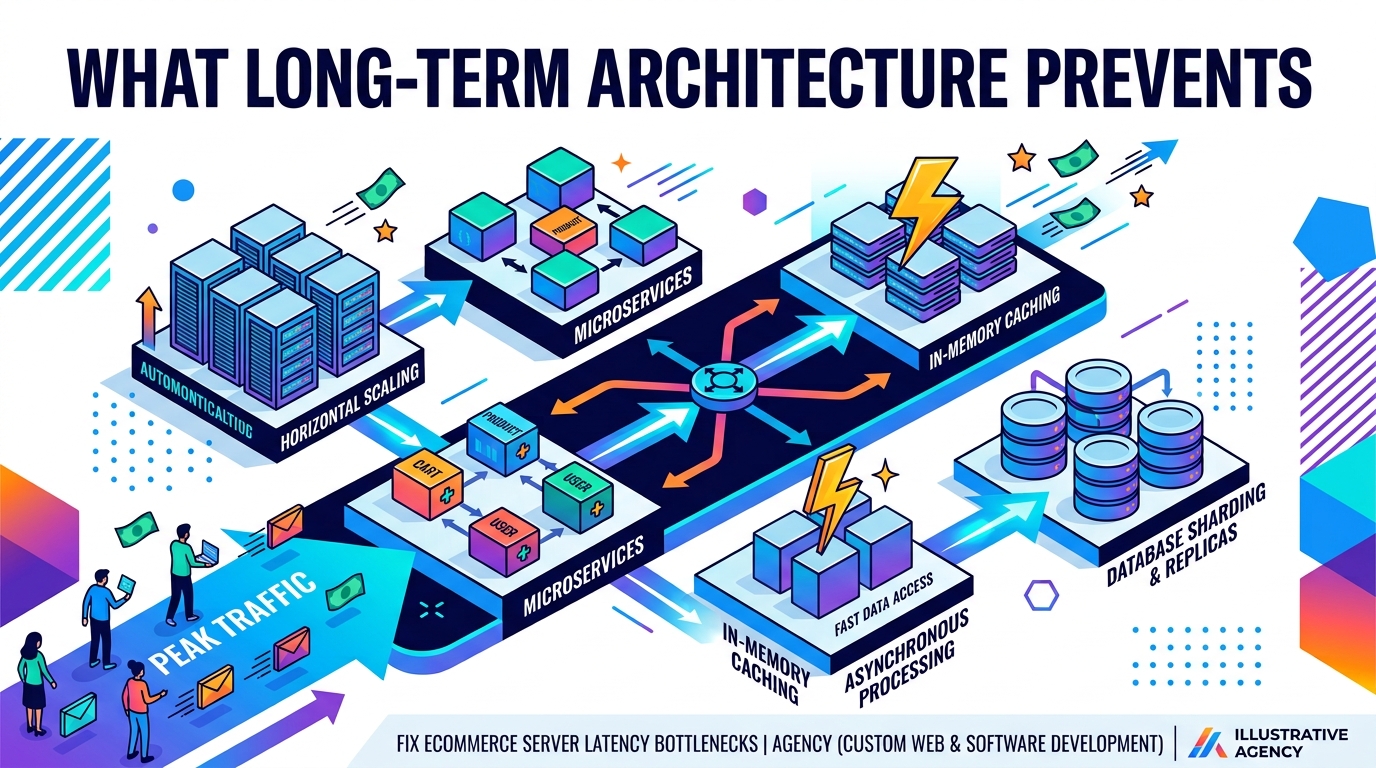
Modern Infrastructure Designs to Fix Ecommerce Server Latency Bottlenecks
Flash sales bring sudden traffic rushes. Your database freezes. Your checkout page stalls out completely. Throwing more memory at an old server won't work. As engineers on Reddit's dev community note when scaling architectures, relying on one big server always creates a single point of failure. You must decouple your system components so heavy traffic spikes get absorbed naturally without breaking your store.
Understanding core network flow mechanics helps you eliminate hidden transport delays across server boundaries.
Preventing peak season site crashes requires four connected engineering practices:
- Auto-Scaling Cloud Clusters: Configure AWS or Google Cloud to launch extra web nodes instantly when CPU usage hits 70%. Servers scale back down automatically when traffic drops.
- Headless Decoupling: Separate your front-end customer interface from your back-end inventory database. Storefront pages load fast as lightweight static assets, while dedicated database workers handle secure payment queues.
- Dynamic Edge Caching: Cache catalog pages and API responses right near your buyers using Cloudflare or Fastly. This keeps repetitive read requests far away from your primary database.
- Proactive Load Testing: Run simulated traffic spikes with k6 or Apache JMeter every week. You'll catch hidden software bugs long before real shoppers hit your payment page.
| Architecture Model | Peak Traffic Resilience | Average Server Latency |
|---|---|---|
| Legacy Monolith | High risk of server memory crashes | Slow (800ms - 3,000ms+) |
| Decoupled Cloud-Native | Absorbs huge traffic spikes automatically | Fast (<150ms globally) |
Re-engineering an enterprise store requires specialized backend expertise. Our official Ecommerce Solutions directly from InDevXo deliver proven, enterprise-grade architecture upgrades built for heavy traffic loads. We build resilient auto-scaling systems and custom caching layers that keep your checkout fast during your biggest promotional sales.
"Auto-scaling extra servers hides underlying code flaws, but true headless separation eliminates backend database strain entirely."
Eliminate Latency and Scale Your Online Store with Confidence
Slow servers silently drain your checkout pipeline. When shoppers hit click, they expect instant responses. Industry metrics show that every 100ms of latency costs 1% in e-commerce sales. Maintaining sub-second response times keeps buyers engaged and directly protects your bottom line.
To fix ecommerce server latency bottlenecks for good, you must tackle backend bottlenecks directly. Smart store owners pair robust object caching through Redis with deep application performance monitoring tools like New Relic. Redis stores frequent database requests in memory to eliminate repeated server calls. Meanwhile, APM platforms pinpoint slow queries and unoptimized scripts in real time. Eliminating database locks and offloading heavy assets to the edge keeps your infrastructure fast under heavy load.
Technical debt builds up quietly behind the scenes. As experienced store founders on Reddit's e-commerce community highlight, partnering with experts step-by-step prevents overwhelm and helps build a sustainable business.
Managing server growth requires understanding performance trade-offs and resource optimization. The video lesson below explains core economic and resource efficiency concepts that apply directly to server capacity planning:
Streamline Infrastructure to Fix Ecommerce Server Latency Bottlenecks
You don't have to battle backend delays alone. Patching server scripts only provides temporary relief as your product catalog grows. Flash sales and holiday traffic spikes demand an enterprise-grade backend built for high concurrency.
Upgrade your platform with total confidence today. Deploy InDevXo's official Ecommerce Solutions to unlock guaranteed system speed, optimized database queries, and direct technical support straight from the authentic provider. Protect your conversion rates and scale your online store without server slowdowns holding you back.